

Animal farming in Ghana has traditionally revolved around poultry and conventional livestock such as chickens, pigs, sheep, and goats. These sectors dominate policy conversations, training programs, and private investment. Yet quietly, in markets and homes across Ghana, snails remain a prized delicacy—highly sought after, nutritionally rich, and culturally significant. Despite this strong consumer demand, snail farming (heliciculture) is still largely underdeveloped, practiced mainly by smallholder farmers in scattered pockets of the country.
This gap between demand and structured production presents a compelling opportunity. For young entrepreneurs, urban dwellers, and small landowners, snail farming offers a practical pathway to generate meaningful income within a relatively short production cycle.

A High-Value Enterprise for Small Spaces
One of the strongest advantages of snail farming is its minimal land requirement. Unlike poultry or ruminant production, which often require larger spaces and strict zoning considerations, snails can be reared efficiently in compact environments. A small backyard, unused corner of a compound, or even a well-designed pen system can support hundreds of snails.
In urban centers such as Accra and Kumasi, where land costs are high and space is limited, this characteristic is particularly valuable. A basic snail pen of just 4m x 4m can accommodate several hundred growing snails under proper stocking density. With good management, survival rates of 70–90% are achievable, depending on breed and husbandry practices.The most commonly farmed species in West Africa include Achatina achatina and Archachatina marginata, both of which are indigenous and well adapted to Ghana’s humid forest and transitional zones. Mature snails can weigh between 150–400 grams depending on species and management quality, making them commercially attractive.

Low Capital, Strong Returns
Compared to poultry or piggery, snail farming requires significantly lower startup capital. There is no need for expensive feed formulations, heavy housing infrastructure, or continuous medication. Snails thrive on readily available feed resources such as pawpaw leaves, cocoyam leaves, cabbage, lettuce, plantain peels, and other vegetable waste. Calcium supplements (such as ground eggshells or limestone) are added to strengthen shell development, but these inputs remain affordable.
While startup costs vary depending on scale, a small snail farm of 200–500 snails can be established with relatively modest capital compared to broiler production of the same financial value. In addition, snails have a feed conversion advantage: they consume less feed relative to their weight gain compared to many conventional livestock species.
Market prices further strengthen the business case. In many Ghanaian markets, a mature snail sells between GHS 10 and GHS 25 depending on size and season. During festive periods and dry seasons—when wild snails are scarce—prices often rise significantly. A well-managed farm producing 1,000 market-size snails per cycle can therefore generate substantial revenue, especially if farmers target hotels, restaurants, and exporters.
Strong Demand and Year-Round Market Potential
Snails are widely consumed across Ghana and other parts of West Africa. They are valued not only for taste but also for their nutritional profile. Snail meat contains approximately 16–20% protein, is low in fat (often below 2%), and is rich in essential minerals such as iron, magnesium, and calcium. For health-conscious consumers, this makes snail meat an attractive alternative to red meat.
In the wild, snails depend heavily on rainfall and humidity. During prolonged dry seasons, they aestivate (a form of hibernation), burying themselves underground to survive harsh conditions. This natural cycle causes seasonal shortages in the open market and drives price fluctuations.
Heliciculture solves this problem by creating controlled environments with adequate moisture, shade, and feed throughout the year. By managing humidity levels and proper housing, farmers can maintain continuous production cycles. This means consistent supply when wild harvesters cannot meet demand—an advantage that directly translates into higher and more stable income.
Rapid Multiplication and Farm Expansion
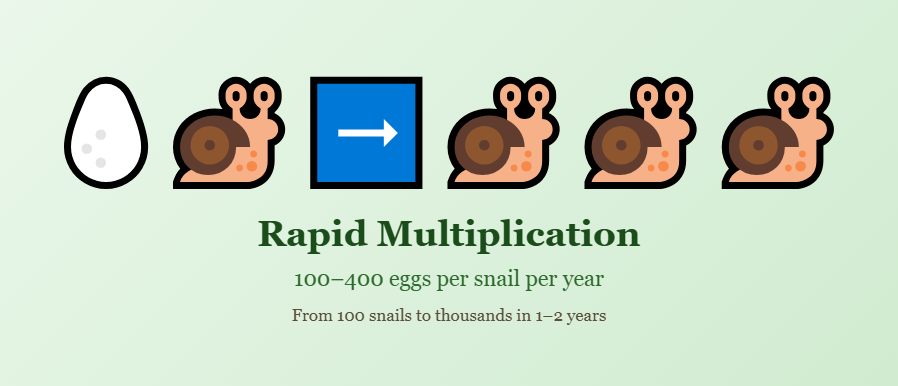
Another compelling feature of snail farming is its high reproductive potential. Most giant African land snails are hermaphrodites, meaning each mature snail possesses both male and female reproductive organs. Under optimal conditions, a mature snail can lay between 100 and 400 eggs per year, depending on species and management.
Eggs typically hatch within 21–35 days under suitable temperature and humidity. With proper incubation and nursery management, hatchability rates can exceed 70%. This reproductive efficiency allows farmers to scale quickly. What begins as a small pilot project of a few hundred snails can expand into several thousand within a year or two if managed strategically.
However, expansion must be controlled. Overstocking, poor hygiene, and inadequate calcium supply can reduce growth rates and increase mortality. Success in snail farming depends not just on numbers, but on disciplined management, record-keeping, and environmental control.

A Strategic Opportunity for Ghana’s Agripreneurs
For a country actively pursuing agricultural diversification and youth employment, snail farming presents a realistic and scalable opportunity. It aligns well with urban agriculture, climate-smart farming systems, and low-emission livestock production. Snails produce minimal odor, generate little waste, and require no noisy equipment—making them suitable even in peri-urban environments.
For agripreneurs, especially those with limited land and capital, heliciculture is not merely a side activity; it can be a structured, profitable enterprise when approached professionally. With improved training, aggregation models, and access to premium markets such as restaurants and supermarkets, snail farming can move from being an overlooked activity to a recognized agribusiness sector.
In a landscape dominated by poultry and conventional livestock, snail farming remains an unsung gold mine. For those willing to understand the science, commit to proper management, and build reliable market linkages, the opportunity is real—and the returns can be significant.





Interested